
Practical car tutorial
Battery or Alternator? How to Tell What’s Actually Causing the Problem
A no-start, dim lights, or repeated dead battery can point to the battery, charging system, connections, or something else. Learn how to narrow it down safely.
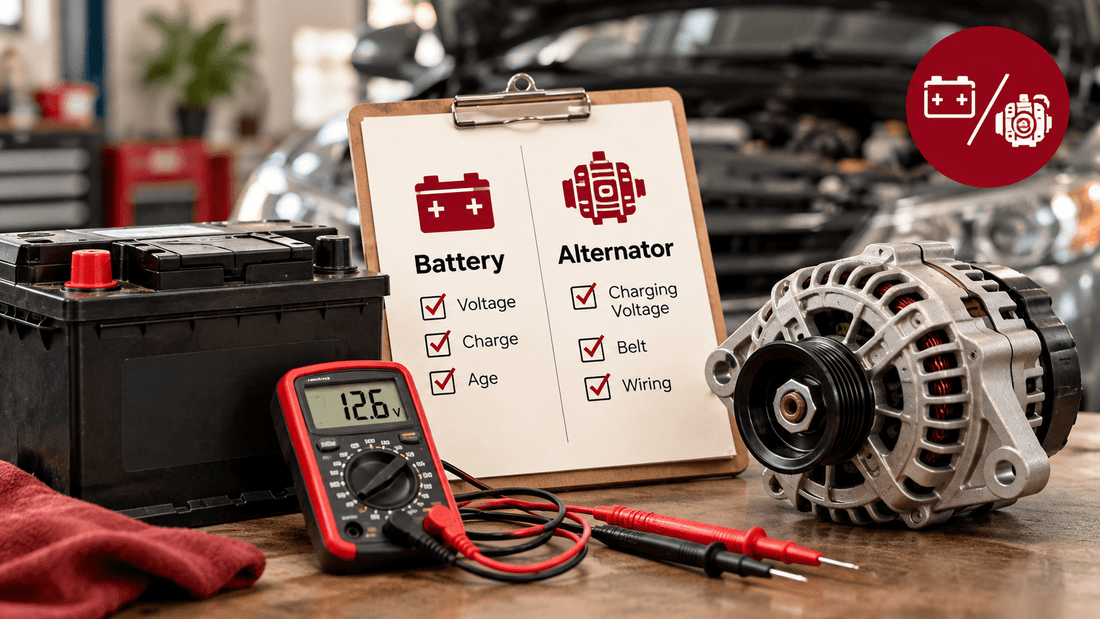
Your car will not start. The lights look weak. Maybe the battery needed a boost yesterday and it is dead again today. It is tempting to blame the battery immediately—but a weak battery and a charging-system problem can create very similar symptoms.
The useful question is not “battery or alternator?” as quickly as possible. It is: Is the battery failing, is it not being charged properly, or is something else preventing the vehicle from starting?
What the battery does
The 12-volt battery provides the electrical energy needed to power the vehicle before the engine is running, including the starter motor and many control modules.
A weak or discharged battery can cause:
- slow cranking;
- rapid clicking when you try to start;
- dim interior or exterior lights;
- electrical systems resetting;
- a vehicle that starts after a boost but may not restart later.
Those symptoms can point toward the battery—but they do not prove the battery itself is defective. A healthy battery can become discharged if the charging system is not replenishing it or if another electrical load is draining it while the vehicle is parked.
What the alternator and charging system do
Once the engine is running, the charging system supplies electrical power and replenishes the battery. The alternator is a major part of that system, but wiring, battery connections, drive components, fuses, sensors, and electronic charging controls can also matter.
Possible charging-system symptoms include:
- a battery warning light while driving;
- lights that change brightness;
- electrical accessories behaving strangely;
- a battery that repeatedly goes dead even after being charged;
- the engine eventually shutting off after a jump-start because the vehicle is not receiving enough charging power.
Clue #1: What happens when you try to start the car?
Slow cranking often suggests low battery voltage, poor battery connections, or a starting-system issue.
Rapid clicking commonly occurs when there is not enough available voltage to keep the starter solenoid engaged.
One solid click with no crank can have other causes, including the starter, electrical connections, relays, or mechanical problems.
No sound at all can point in several directions, so do not assume the battery is automatically the cause.
Clue #2: Does the car start with a boost?
If the vehicle starts with a proper jump-start, that tells you the starting system was able to work once additional electrical energy was supplied. It does not tell you why the battery was low.
Afterward, ask whether the battery was left discharged by lights or accessories, whether the battery is old or weak, whether the terminals are loose or heavily corroded, whether the charging system is working correctly, or whether there is an excessive parasitic draw while the car is parked.
Clue #3: How old is the battery?
Battery life varies with climate, vehicle use, battery type, charging behavior, and storage conditions. Age alone does not diagnose a battery, but an older battery deserves closer attention when starting problems appear.
Clue #4: What do the battery terminals look like?
With the vehicle off, visually inspect the battery area if it is safely accessible. Look for loose terminal connections, heavy corrosion, damaged cables, or a swollen or physically damaged battery case.
Do not handle a damaged, leaking, or swollen battery. Batteries can contain corrosive electrolyte and can release flammable gas.
Can you check voltage with a multimeter?
If you are comfortable using a multimeter and can access the battery safely, voltage measurements can provide useful clues. But one voltage reading is not a complete battery or alternator test.
A fully charged conventional 12-volt lead-acid battery at rest is often around the mid-12-volt range, but battery chemistry, temperature, recent charging, and vehicle design affect the reading.
With the engine running, many vehicles show charging voltage higher than resting battery voltage. However, modern “smart charging” systems can intentionally vary charging voltage, so a simple running-voltage number should not be treated as a universal pass/fail test.
Do not replace the alternator just because the battery keeps dying
Repeated battery discharge can also be caused by a weak battery that no longer holds charge, poor cable connections, a parasitic electrical draw, short-trip driving that never fully replenishes the battery, charging-system wiring or control issues, extreme temperatures, or a component that stays powered when the vehicle is off.
Replacing the alternator without confirming the cause can turn one problem into an expensive guessing game.
When should you stop troubleshooting and get help?
Get professional help if the battery is swollen, leaking, or damaged; you smell burning insulation; the battery warning light stays on while driving; the vehicle repeatedly stalls; you are not comfortable working around the battery or electrical system; or the problem keeps returning after the battery has been charged or replaced.
Related beginner maintenance reading
If you are building your confidence with basic maintenance, start with the monthly car maintenance checklist and 5 beginner-friendly DIY car repairs.
Build your DIY knowledge before buying parts

The DIYER Car Guide is built for car owners who want to understand common repairs and maintenance before spending money or starting a project. Use it to learn what a job involves, what tools may be required, and when a task may be better left to a professional.
Best rule: diagnose first, replace second. A battery, alternator, starter, and electrical connection can all create overlapping symptoms—so the cheapest repair is often the one you confirm before buying parts.
Turn information into action
Continue with the right level of DIYER
The DIYER Car Guide helps you understand essential jobs. DIYER PRO adds tracking for expenses, maintenance, repairs, fuel, documents, and planning.
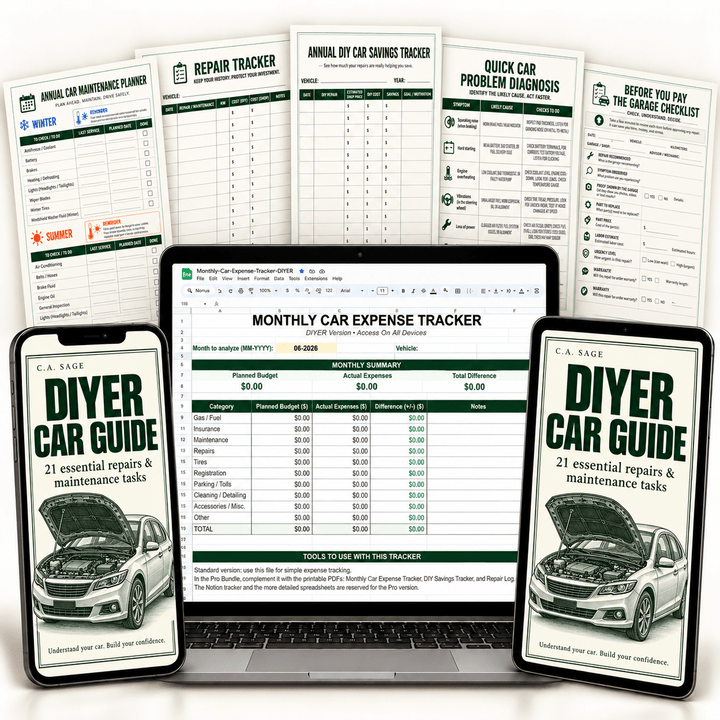
DIYER Car Guide
21 essential repairs and maintenance jobs explained so you know what to check before you begin.
$20.00 USD
See the DIYER Guide
DIYER PRO
A complete system to track your car, expenses, maintenance, repairs, and upcoming ownership costs.
$48.00 USD
See DIYER PROAlready own the DIYER Car Guide? Use the DIYER PRO upgrade instead of buying the guide again.