
Practical car tutorial
How Much Should You Save for Car Repairs? Build a Realistic Car Fund
Learn how to build a realistic car repair fund using your vehicle, expected maintenance, repair history, and a monthly savings target—plus the Annual Car Emergency Fund Planner inside the DIYER Emergency & Road Trip...

Car repairs are one of those expenses that can feel unpredictable until you separate what you can plan for from what you cannot. There is no single “right” amount every driver should save, because a newer low-mileage car, an older high-mileage vehicle, a daily commuter, and a weekend car all have different needs.
The goal is not to predict every future repair. The goal is to build a car fund that can absorb routine maintenance and at least some unexpected repair costs without forcing every problem onto a credit card or your regular monthly budget.
Start with two separate buckets: planned maintenance and unexpected repairs
A realistic car fund works better when you think about it in two layers:
- Planned car costs: oil changes, filters, tires, brakes, inspections, seasonal service, scheduled maintenance, registrations, and other expenses you already know are coming.
- Unexpected repair reserve: money set aside for the repair you did not plan for — a failed sensor, battery, alternator, suspension component, cooling-system problem, electrical issue, or another repair that appears between scheduled services.
When those two categories are mixed together, it is easy to think you have an “emergency fund” when most of it is already spoken for by normal maintenance.
Step 1: List what your car is likely to need over the next 12 months
Start with your own vehicle, not a generic average. Look at your owner’s manual, current mileage, service history, tire condition, brake wear, and any work you already know is coming.
Your list might include:
- oil and filter changes;
- air and cabin filters;
- tire replacement, rotation, or seasonal tire changes;
- brake service;
- battery replacement if it is aging;
- scheduled fluid or maintenance services;
- inspection or registration-related costs;
- known repairs you have been monitoring.
Add those expected costs together. That becomes the planned-maintenance portion of your car fund.
Step 2: Look at the factors that make your repair risk higher or lower
Your emergency reserve should reflect your real situation. Consider:
- Vehicle age and mileage: older vehicles may have more wear-related repairs.
- Warranty coverage: a vehicle still under strong warranty coverage may need a smaller repair reserve than one with no coverage.
- Repair history: your own records can reveal what the car has actually been costing you.
- Annual driving: more kilometres or miles generally means faster wear.
- Climate and road conditions: heat, cold, road salt, potholes, and seasonal driving can all affect wear.
- Your household cash flow: the less room you have in your normal monthly budget for a surprise bill, the more useful a dedicated reserve becomes.
Step 3: Choose a repair-fund target you can actually build
You do not need to fund every possible major repair before your emergency fund becomes useful. A practical approach is to choose a first target that would meaningfully reduce the impact of a typical unexpected repair, then build from there.
If your target feels too large, break it into milestones. Build enough to cover a smaller repair first, then continue until your reserve could absorb a larger bill without disrupting rent, groceries, utilities, or other essential expenses.
The important part is that the target is based on your vehicle and your finances, not a random number copied from someone else.
Step 4: Turn the annual target into a monthly savings amount
Once you know your expected maintenance costs and the repair reserve you want to build, turn the total into a monthly amount:
(Expected annual maintenance + repair-fund contribution) ÷ 12 = monthly car-fund contribution
For example, if you expect about $900 in known maintenance over the next year and want to add $600 to your repair reserve, your annual target would be $1,500. Dividing that by 12 gives you a monthly contribution of $125.
That example is not a recommendation for what you personally should save. It simply shows how to turn your own numbers into a manageable monthly amount.
Step 5: Keep the money separate from everyday spending
Your repair fund is easier to protect when it has a clear purpose. Whether you use a separate savings account, a budgeting category, or another system, label it specifically for car maintenance and repairs.
Then, when you use the fund, record what the money was spent on. That repair history becomes useful information for next year’s plan.
Use your own repair history instead of guessing
If you have one or two years of receipts, service records, or bank transactions, total what you actually spent on maintenance and repairs. Then separate the predictable costs from the unexpected ones.
This gives you a much better starting point than a broad average because it reflects your vehicle, your driving, and your local repair costs.
Make the plan easier with the Annual Car Emergency Fund Planner
This is exactly why I created the Annual Car Emergency Fund Planner. Instead of keeping the numbers in your head, it gives you a practical place to map out the fund, anticipate car expenses, and turn a yearly target into something you can work toward month by month.
The planner is included inside the Emergency & Road Trip Kit — DIYER Auto, together with the Car Emergency Planner, road-trip preparation tools, emergency checklists, and vehicle and emergency records.

Explore the Emergency & Road Trip Kit →
Review your car fund at least once a year
Your target should change as your car changes. Review it when your mileage increases significantly, the vehicle gets older or loses warranty coverage, you complete a major repair, you replace tires or brakes, your driving habits change, or you buy a different vehicle.
A car fund is not something you set once and forget. It becomes more accurate as you collect your own records.
Want to organize your entire car budget too?
If you want to go beyond the emergency fund and track maintenance, repairs, fuel, records, documents, upcoming expenses, and savings together, DIYER PRO — Car Ownership & Finance Manager is the broader C.A. Sage system for managing the financial side of car ownership.
Start with the fund. Build the habit. Then use your own car history to make the plan smarter every year.
Turn information into action
Continue with the right level of DIYER
The DIYER Car Guide helps you understand essential jobs. DIYER PRO adds tracking for expenses, maintenance, repairs, fuel, documents, and planning.
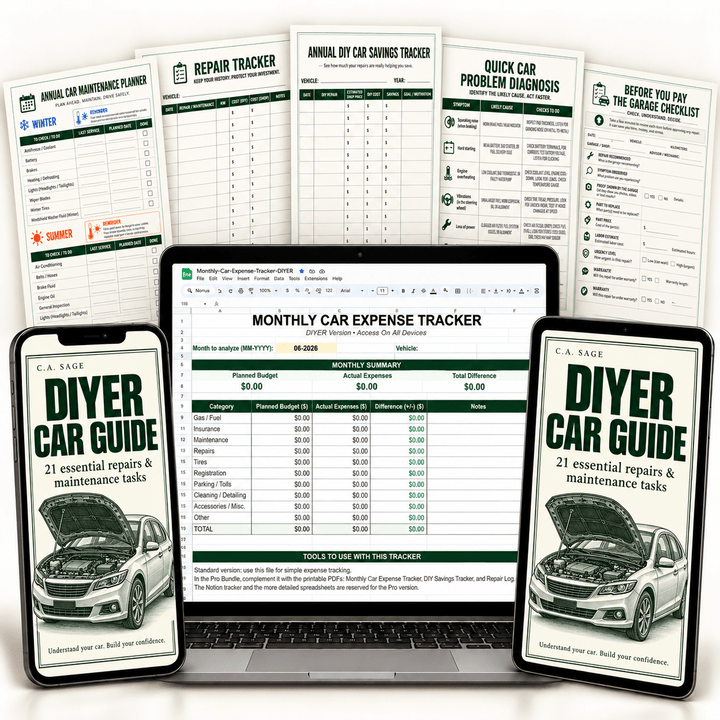
DIYER Car Guide
21 essential repairs and maintenance jobs explained so you know what to check before you begin.
$27.00 CAD
See the DIYER Guide
DIYER PRO
A complete system to track your car, expenses, maintenance, repairs, and upcoming ownership costs.
$67.00 CAD
See DIYER PROAlready own the DIYER Car Guide? Use the DIYER PRO upgrade instead of buying the guide again.